Living just outside Boston usually means more space, quieter streets, and better value than the city itself, with downtown still within reach. The hard part is choosing. Greater Boston has dozens of towns, and the right one depends on your commute, your budget, and whether schools are at the top of your list.
As a Boston moving company working across the region since 2008, we spend our days in these towns: on Somerville triple-decker stairs, in Newton driveways, and outside Quincy condo towers. This guide compares 12 of the most popular Boston suburbs and nearby cities, with what each one is like to live in and what to expect on moving day.
Quick answer
Boston Suburbs at a Glance
Distances are approximate driving miles to downtown Boston. Home values and rents are Zillow’s typical values for September 2026. Transit times are scheduled weekday morning trips on the MBTA. Sources are listed at the end of the article.
| Town | Miles to downtown | Fastest transit to downtown | Typical home value | Typical rent | Best for |
|---|---|---|---|---|---|
| Somerville | 3 | Red Line, Davis to Park St: 15 min | $920K | $3,430/mo | Young professionals |
| Brookline | 4 | Green Line C, Coolidge Corner to Park St: 25 min | $1.12M | $3,490/mo | City access with top schools |
| Arlington | 7 | Bus 77 to Harvard: about 30 min (no rail) | $1.06M | $2,930/mo | Close-in suburban life |
| Newton | 8 | Green Line D, Newton Centre to Park St: 37 min | $1.48M | $3,360/mo | Families |
| Quincy | 8 | Commuter rail to South Station: 19 min (Red Line: 23 min) | $674K | $2,710/mo | Value with a subway commute |
| Waltham | 11 | Commuter rail to North Station: 28 min | $807K | $2,930/mo | Restaurants and Route 128 jobs |
| Dedham | 11 | Commuter rail to South Station: 27–30 min | $757K | $2,910/mo | Value close to the city |
| Lexington | 12 | Bus 62 or 76 to Alewife: 21–30 min (no rail) | $1.55M | $3,520/mo | Schools and history |
| Needham | 12 | Commuter rail to South Station: 36–44 min | $1.54M | $3,700/mo | Families |
| Wellesley | 14 | Commuter rail to South Station: about 40 min | $2.01M | $4,030/mo | Larger homes and schools |
| Norwood | 15 | Commuter rail to South Station: about 40 min | $728K | $2,580/mo | Affordable family homes |
| Framingham | 21 | Commuter rail to South Station: 46–56 min | $657K | $2,300/mo | The most space for the money |
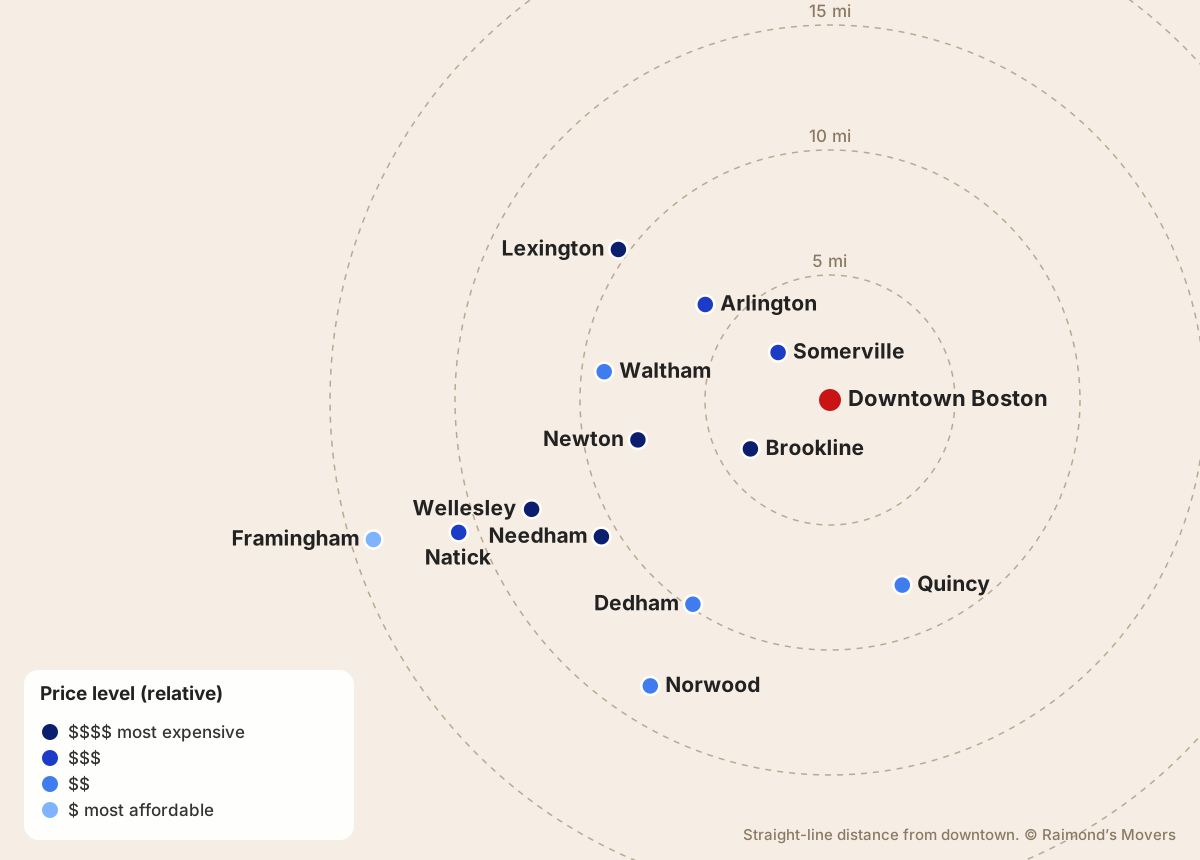
How to Choose a Boston Suburb
Before you compare towns, settle three things:
- Your commute. If you work downtown and want to skip the car, stick to towns on the Red Line or Green Line. Commuter rail works well for a 9-to-5 schedule but runs less often, especially on weekends.
- Your budget. Towns closer to Boston and along Route 128 to the west cost the most. The same budget usually buys noticeably more space to the south and in MetroWest.
- Schools and space. If you have or are planning children, school reputation and yard size tend to narrow the list quickly.
Best Boston Suburbs for Families
Newton
Best for: families who want strong schools and transit options. Newton is a city of 13 villages, each with its own center, from Newton Centre and West Newton to Chestnut Hill and Auburndale. The Green Line D branch runs through the southern villages, and commuter rail stops at Newtonville, West Newton, and Auburndale.
Housing: mostly single-family homes, from Victorians to newer colonials, plus condos near the village centers. Moving tip: large homes with basements and long driveways take longer to load, so plan for a bigger crew. See our Boston to Newton movers page for more.
Needham
Best for: families who want a quieter town with a classic downtown. Needham has its own commuter rail line with four stops into Boston and sits right on Route 128, which makes it popular with people who work in the western suburbs.
Housing: colonials and capes on tree-lined streets, plus newer construction. Moving tip: many homes have finished basements full of furniture and storage, so include them in your inventory. Our Needham movers page has more detail.
Wellesley
Best for: families who want larger homes and well-regarded schools and have the budget for them. Wellesley has three commuter rail stations on the Worcester Line and a walkable town center, along with Wellesley College and Babson College.
Housing: mostly single-family homes, many on larger lots. Moving tip: big homes often mean high-value furniture, art, and antiques, which is where white glove moving makes sense.
Lexington
Best for: families focused on schools who don't mind driving. Lexington is known for its history (the first battle of the American Revolution) and for the Minuteman Bikeway. There is no train, but MBTA buses connect to the Red Line at Alewife.
Housing: single-family colonials and mid-century contemporaries. Moving tip: moves here are almost always from driveway to driveway, which keeps loading quick when the driveway is clear.
Best Boston Suburbs for Commuters
Brookline
Best for: people who want suburban streets with city-level access. Brookline is surrounded by Boston on three sides, and the Green Line C and D branches run through it. Coolidge Corner and Brookline Village have plenty of shops and restaurants.
Housing: brownstones, condo buildings, and large single-family homes in areas like Chestnut Hill. Moving tip: street parking is tight in the busier neighborhoods, so plan where the truck will stand before moving day. See our Boston to Brookline movers page.
Somerville
Best for: young professionals who want to stay close to everything. Somerville borders Cambridge and has Red Line service at Davis plus the newer Green Line stations at Union Square and along the Medford branch. Squares like Davis, Union, and Assembly are full of restaurants.
Housing: mostly two- and three-family houses, plus newer apartments near Assembly Row. Moving tip: triple-deckers mean narrow, turning stairwells, and September 1 is extremely busy here, so book early and measure large furniture.
Quincy
Best for: a subway commute at a better price than the city. Quincy has four Red Line stations (North Quincy, Wollaston, Quincy Center, and Quincy Adams), commuter rail at Quincy Center, and miles of coastline.
Housing: condos and new apartment buildings near the Red Line, plus capes and two-families in neighborhoods like Wollaston. Moving tip: most larger buildings require an elevator reservation and set move-in hours, so ask your building manager early.
Arlington
Best for: suburban life a short ride from Cambridge. Arlington has no train, but buses run to the Red Line at Alewife and to Harvard Square, and the Minuteman Bikeway connects it to both Lexington and Cambridge.
Housing: two-family homes and colonials, many on hills. Moving tip: steep driveways and front steps add time, so mention them when you ask for an estimate.
Most Affordable Boston Suburbs
Dedham
Best for: value close to the city. Dedham borders Boston's West Roxbury neighborhood, has two commuter rail stations on the Franklin Line, and gets plenty of shopping at Legacy Place. Our own office is in Dedham, so we know it well.
Housing: capes, colonials, and older homes near Dedham Square. Moving tip: older homes can have narrow doorways and staircases, so let us know about large pieces in advance. Visit our Dedham movers page.
Norwood
Best for: families looking for an affordable single-family home. Norwood has three commuter rail stations on the Franklin Line and easy access to Route 1, I-95, and Route 128.
Housing: capes, ranches, and colonials, plus apartment complexes. Moving tip: Route 1 traffic can add time on weekday afternoons, so morning starts are usually smoother. See our Norwood movers page.
Waltham
Best for: people who work along Route 128 and want a lively downtown. Moody Street is one of the best restaurant strips outside Boston, the Charles River runs through the city, and the Fitchburg Line stops at Waltham and Brandeis/Roberts.
Housing: multi-family homes on the South Side, single-family homes in neighborhoods like the Highlands, and apartments throughout. Moving tip: plan street parking in the busier areas near Moody Street. Our Waltham movers page has more.
Framingham
Best for: the most space for your money within reach of Boston. Framingham is the largest community in MetroWest, with commuter rail on the Worcester Line, Route 9 and the Massachusetts Turnpike, and plenty of local jobs. Nearby Natick offers a similar mix with a smaller downtown.
Housing: everything from apartments along Route 9 to single-family homes in Saxonville and Nobscot. Moving tip: at about 20 miles from Boston, the drive is part of the job, so an early start helps. See our Framingham movers page.
Best Suburbs South of Boston
South of the city, Quincy, Dedham, and Norwood give you more space for the money with commuter rail or the Red Line into Boston. Two more towns worth a look:
- Milton: a leafy, mostly single-family town on Boston’s southern edge, next to the Blue Hills Reservation. The Mattapan trolley connects to the Red Line at Ashmont. Prices are on the higher side.
- Braintree: the end of the Red Line’s southern branch, with commuter rail as well, plus easy highway access to the South Shore. Housing is mostly single-family homes at mid-range prices.
Best Suburbs North of Boston
North of the city, Somerville and Arlington are the closest options. Further out:
- Medford: home to Tufts University, with Green Line service on the Medford/Tufts branch and the Orange Line at Wellington. A mix of two-families and single-family homes.
- Melrose: known for its Victorian homes and a walkable downtown, with commuter rail on the Haverhill Line and the Orange Line at Oak Grove just over the line in Malden.
Moving From Boston to the Suburbs
Moving out of the city usually means more furniture, more boxes, and a bigger home on the other end. A few things make it easier:
- Book early around September 1. Thousands of Boston leases turn over that day, so crews and trucks fill up weeks ahead. Our guide to Boston Moving Day explains why.
- Plan parking at both ends. City streets usually need a parking permit or reserved space for the truck, while suburban homes usually have a driveway.
- Use storage if the dates don't line up. A closing that slips or a lease that ends early is common, and short-term storage bridges the gap.
- Know what it will cost. Moves within Greater Boston are billed by the hour, starting at $119/hr for 2 movers and a truck. See our moving rates.
Raimond's Movers handles local moves across Greater Boston and long-distance moves if you are coming from another state. When you have picked your town, get a free moving quote or call us at (617) 681-8181.
“Thank you for a painless moving experience on the busiest move-in day of the year!”
Suparna S., on Yelp
“They were loading all our stuff very careful but extremely fast and efficient. Especially when you pay hourly it’s great to see people not wasting your money nor time.”
Dziana K., on Yelp
About This Guide
This guide was written by the team at Raimond’s Movers, a Boston moving company since 2008 with an office in Dedham. Our crews work in every town on this list. We compared towns within about 20 miles of downtown on commute, housing, price, and what moving day is like there.
- Licensed mover: MDPU #31418, DOT #1797448
- 405 reviews on Yelp, rated 4.8, and 180 reviews on Google, rated 4.8
- Prices change quickly; check current listings before you decide
Sources
- Typical home values: Zillow Home Value Index (ZHVI), September 2026, Zillow Research
- Typical rents: Zillow Observed Rent Index (ZORI), September 2026, Zillow Research
- Transit times and stations: MBTA schedules, weekday morning service, November 2026
- Newton’s villages: City of Newton
Frequently Asked Questions
What is the best suburb of Boston for families?
Newton, Needham, Wellesley, and Lexington are the usual top picks for families because of their well-regarded public schools, parks, and single-family homes. They are also among the most expensive. Families on a tighter budget often look at Dedham, Norwood, Waltham, or Framingham.
What are the most affordable suburbs near Boston?
Among the towns in this guide, Framingham (typical home value about $657K in September 2026), Quincy ($674K), Norwood ($728K), Dedham ($757K), and Waltham ($807K) cost the least. Brookline, Newton, Needham, Lexington, and Wellesley all sit above $1.1M. Prices change quickly, so compare current listings before you decide.
Which Boston suburbs have the easiest commute without a car?
Somerville, Brookline, and Quincy have subway service (the Red Line or Green Line) straight into Boston. Newton has the Green Line and commuter rail. Needham, Wellesley, Dedham, Norwood, Waltham, Natick, and Framingham rely on commuter rail, which runs less often.
How much does it cost to move from Boston to a suburb?
Moves within Greater Boston are billed by the hour. Raimond’s Movers starts at $119/hr for 2 movers and a truck, $179/hr for 3, and $239/hr for 4. The total depends on how much you are moving, stairs and parking at both addresses, and the time of year.
When is the best time to move to the Boston suburbs?
Fall and winter weekdays are usually the easiest to book and the least expensive. Late August and September 1 are the busiest days of the year in Greater Boston, so book several weeks ahead if your lease ends then.